
Am I Going to Get Bumped Into a Higher Bracket?
Hi there.
There are a lot of people out there who are afraid of making more money. Take a young single friend of mine who shared with me that he’s worried he might get a promotion. That might sound strange, but when you hear the reason it starts to make sense.
(Some math incoming, but I’m trying to make it brief. To that end, I’m vastly over-simplifying things. We’re not going to discuss standard deductions, tax credits, FICA (Social Security & Medicare), or state/local taxes.)
My friend, we’ll call him George, is a single filer making right around $50,000 a year. That puts him in the 12% tax bracket. George is super worried about getting a promotion that will bring him around $60,000 a year. While that seems great, he’s concerned about the fact that his taxes will go from 12% all the way up to 22% when he jumps into the next bracket. The more he makes, the less he keeps from every paycheck.
Fortunately for George, it doesn’t work that way.
This common misconception is the difference between Effective Tax rates and Marginal Tax rates. Effective Tax is your average tax rate across all your income sources and tax brackets. The Marginal Tax rate is the highest bracket that you fall into, but NOT what most of your income is taxed at. Most Americans know we have a progressive tax system that gets higher and higher as income increases. Unfortunately, most don’t realize that our progressive tax system is built on buckets, and it makes the playing field a lot more level than people are afraid of.
Imagine a bucket. It’s a big bucket, because we’re going to fill it with money. The first bucket is the smallest, because for a single filer it only holds around $12,000. There’s a big 10% stamped on the front of it. George fills that bucket with his income first. The next bucket is bigger, and has a 12% stamped on it. It holds all money that he earns between roughly $12,000 and $50,000. So we put that $38,000 in that bucket. The bucket after that has a big 22% stamped on it, and it’s another large bucket. It holds the money that covers earnings up to $105,000 or so. George will only have to put around $10,000 in that bucket after his promotion. It looks a little something like this:
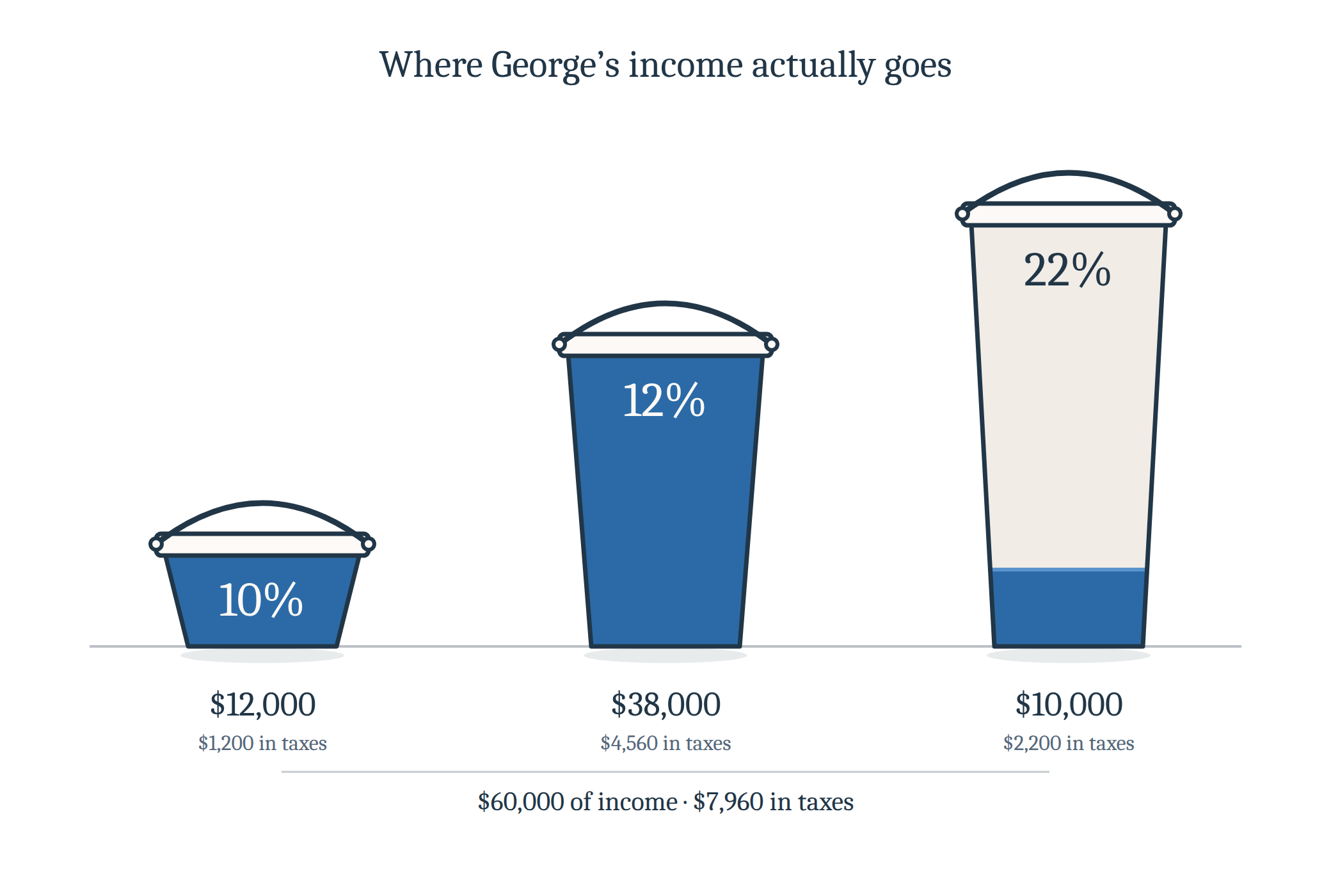
As we fill the buckets with more income, the additional money we earn is taxed at the higher marginal tax rate.
That’s not really what I want to say though. Most people have heard that explanation too, but for some reason it gets lost when we’re faced with an opportunity or decision that might lead to higher income: job promotion; changing careers; larger retirement withdrawals; selling a second home.
Experts often answer this question with a percentage:
After the $10,000 pay raise, George’s effective tax rate is 13.27%.
What George is actually looking for is a dollar amount:
After the $10,000 pay raise (and federal income tax), $7,800 of that raise stays with George.
We don’t buy groceries with percentages, so focusing on the dollars and talking to a qualified tax professional is the way to go. And ask yourself the question: “Ok, so in dollars – How much more money do I actually get to keep?” Nobody ever gets poorer from a raise.
Until next time, God Bless.
Ian
I’m not a tax accountant or CPA – this is education and not tax advice. Seek qualified tax advice from a licensed tax advisor.
